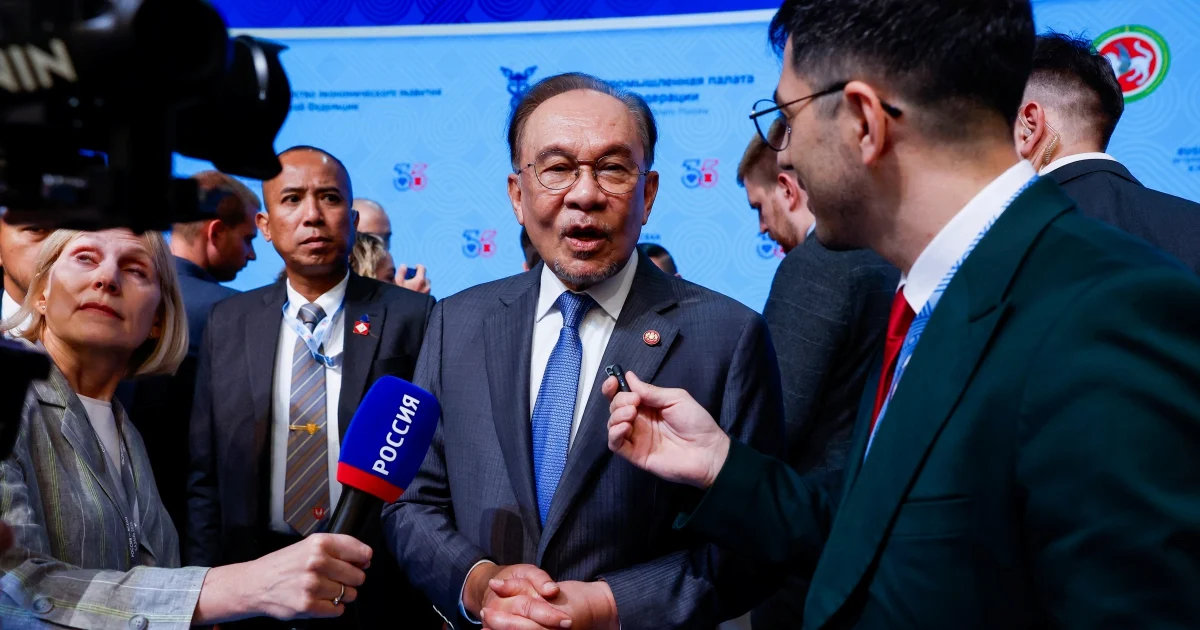
Prime Minister Datuk Seri Anwar Ibrahim has articulated a nuanced vision of Malaysia-Russia relations that extends well beyond commercial transactions and strategic partnerships, positioning cultural engagement as equally consequential to economic cooperation in building sustained diplomatic ties. Speaking in Kazan, Anwar disclosed a personal appreciation for Russian musical traditions and literary works, signalling through his remarks that nations derive lasting benefit from fostering grassroots connections that transcend government channels and trade agreements.
The Prime Minister's candid disclosure about his own cultural interests carries particular weight given Malaysia's ongoing efforts to deepen engagement with Russia amid shifting geopolitical dynamics in Asia-Pacific. By publicly acknowledging his fondness for Russian arts, Anwar has modelled the kind of intercultural curiosity that diplomats and policymakers hope will permeate bilateral relations at institutional and societal levels. This approach recognises that durable partnerships are anchored not only in mutual economic advantage but in genuine appreciation for each nation's civilisational contributions and intellectual heritage.
Anwar's emphasis on cultural exchange reflects a broader strategic understanding increasingly prevalent among Southeast Asian leaders that soft power and people-to-people connectivity provide counterweights to purely transactional relationships. In the context of Malaysia's balancing act between major powers, his words suggest an intention to build multilayered connections with Russia that cannot be easily disrupted by shifts in commodity prices, geopolitical tensions, or changes in government. Cultural ties, once woven into educational curricula, artistic collaborations, and literary circles, develop their own momentum and institutional resilience.
Russian literature, with its psychological depth and philosophical preoccupations, has long attracted intellectually engaged readers across the Islamic world, despite Cold War-era ideological barriers. Authors such as Dostoevsky, Tolstoy, and Chekhov explored universal human dilemmas that resonate across cultural boundaries, making Russian intellectual traditions accessible to Malaysian audiences regardless of religious or political affiliation. That Anwar, as head of government, identifies with these works suggests an openness to engagement with Russian thought that can facilitate dialogue at multiple levels of society.
The Prime Minister's reference to Russian music similarly indicates appreciation for an art form with deep populist roots in Russia itself. Russian classical compositions and folk traditions have influenced musicians globally, and contemporary interest in Russian culture within Malaysia, though modest compared to Western or East Asian influences, represents untapped potential for cultural programming and educational exchange. Investment in translating Russian literary works into Malay and English, hosting Russian musical performances in Malaysian cities, and facilitating artist exchanges would operationalise the sentiment Anwar has expressed.
From a Malaysian perspective, Anwar's comments underscore the importance of not ceding cultural space to Western narratives about Russia or allowing geopolitical divisions to erect barriers to artistic and intellectual encounter. Malaysia's own multicultural society, built on synthesis of diverse traditions, benefits from exposure to different civilisational perspectives. Russian contributions to global arts and thought, whether through the novels of the nineteenth century or contemporary cinema and music, enrich the intellectual marketplace to which Malaysians have access.
The timing of these remarks is instructive, coinciding with Malaysia's efforts to strengthen relationships across the Eurasian landmass as part of its Look North and broader regional engagement strategies. While Malaysia maintains its non-aligned posture and primacy of Asean, deepening ties with Russia through multiple channels—including cultural ones—offers diversification of partnerships that enhances rather than compromises Malaysia's strategic autonomy. Cultural exchange, being inherently reciprocal and mutually enriching, avoids the zero-sum dimensions that can characterise purely economic or security-focused relationships.
For educational institutions and cultural agencies in Malaysia, Anwar's remarks provide policy impetus to expand programmes fostering familiarity with Russian language, literature, and arts. Universities might expand course offerings in Russian studies; cultural centres could host exhibitions and performances; translation projects could bring Russian literary classics to Malay-speaking readers. These institutional responses would give substance to the diplomatic sentiment the Prime Minister has articulated and create pathways for ordinary Malaysians to engage with Russian culture beyond government-level interactions.
The Prime Minister's approach also implicitly challenges a potential Malaysian tendency to regard international relations through a purely utilitarian lens focused on trade volumes, investment flows, and security arrangements. By elevating culture to equal importance with economics, Anwar positions Malaysia as a nation that values civilisational dialogue and intellectual exchange. This positioning may enhance Malaysia's soft power in global forums and reinforce its self-conception as a bridge-building nation capable of fostering understanding among diverse peoples.
Moving forward, the substance of Anwar's cultural advocacy will be tested through concrete initiatives and resource allocation. Whether Malaysia's government bodies, academic institutions, and cultural organisations translate the Prime Minister's expressed appreciation for Russian culture into sustained programming and exchange mechanisms will determine whether these remarks represent a meaningful shift in Malaysia-Russia engagement or remain largely rhetorical. The window for building deeper people-to-people connections exists, and Anwar's public endorsement of cultural diplomacy provides both justification and opportunity for Malaysian institutions to invest in this dimension of international relations.