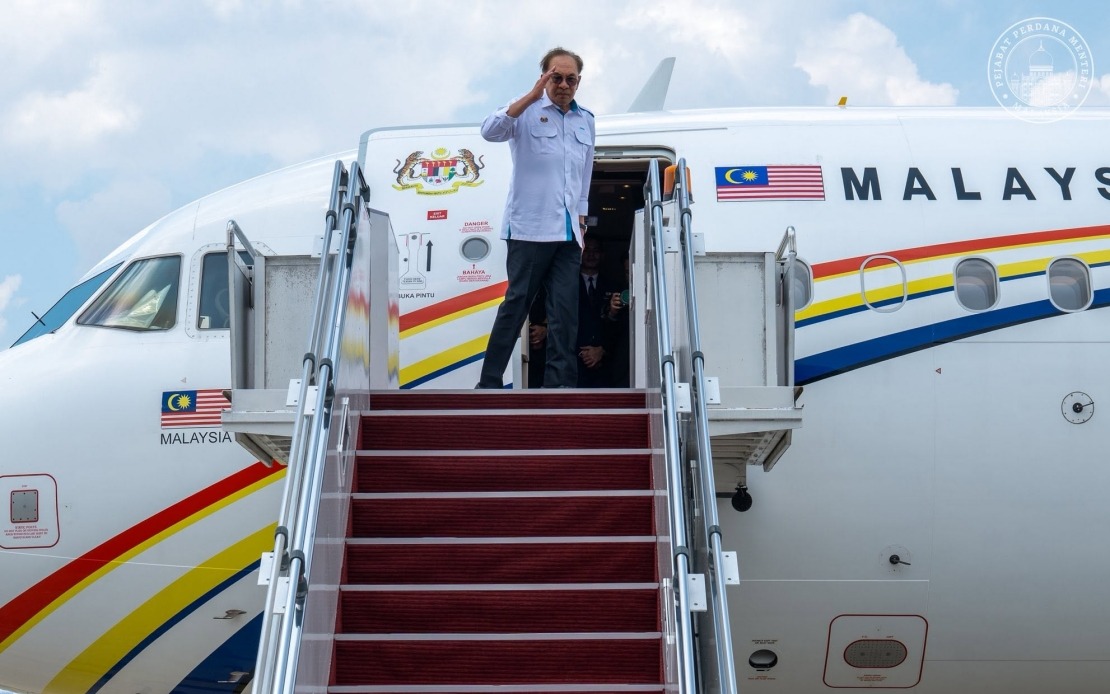
Prime Minister Datuk Seri Anwar Ibrahim departed from Subang Air Base on Sunday to attend the ASEAN-Russia Commemorative Summit in Kazan, underscoring Malaysia's commitment to deepening ties with Moscow during a period of significant geopolitical realignment. The two-day summit, scheduled for June 17 and 18, celebrates three and a half decades of formal relations between the ten-member ASEAN bloc and the Russian Federation, a milestone that reflects evolving partnerships in Southeast Asia's broader foreign policy landscape.
Anwar will undertake a series of bilateral and multilateral engagements during his stay in the Russian city. A scheduled one-on-one meeting with Russian President Vladimir Putin represents a crucial opportunity to discuss bilateral matters and Malaysia's strategic interests in the context of Moscow's expanding role in Asian affairs. Beyond the bilateral dimension, the Prime Minister will participate in the Russia-ASEAN Business Forum, an event designed to facilitate commercial interactions and identify fresh avenues for economic cooperation between Russian enterprises and Southeast Asian counterparts.
The Malaysian delegation arrives with a high-level contingent reflecting the significance Malaysia attaches to the visit. Accompanying Anwar are Minister of Investment, Trade and Industry Datuk Seri Johari Abdul Ghani and Minister of Economy Akmal Nasrullah Mohd Nasir, alongside senior officials from the Prime Minister's Office and the Foreign Ministry. This composition signals Malaysia's intent to translate diplomatic engagement into concrete economic and investment outcomes, particularly given the recent emphasis on expanding Malaysia's commercial partnerships across diverse geographies.
Following the conclusion of his Kazan programme, Anwar will proceed to Ashgabat to undertake an official state visit to Turkmenistan at the personal invitation of President Serdar Berdimuhamedow. This onward journey extends Malaysia's diplomatic engagement in Central Asia, a region that has assumed heightened importance in Malaysian foreign policy calculations as Kuala Lumpur seeks to strengthen ties beyond its traditional Southeast Asian neighbourhood. The back-to-back visits to Russia and Turkmenistan demonstrate a deliberate strategy to enhance Malaysia's presence and influence in the Eurasian sphere.
The ASEAN-Russia Commemorative Summit carries particular significance as it marks 35 years since the establishment of formal relations between the regional organisation and Russia in Kuala Lumpur during 1991. This anniversary represents not merely a historical milestone but an opportunity for both parties to evaluate the trajectory of their relationship and recalibrate priorities for the next phase of cooperation. The passage of three and a half decades has witnessed substantial evolution in regional dynamics, technological advancement, and shifting economic interdependencies that warrant comprehensive reassessment.
According to the Foreign Ministry, the gathering will enable ASEAN and Russia to conduct a thorough review of accomplishments achieved throughout the past 35 years whilst establishing a forward-looking agenda aligned with the ASEAN-Russia Strategic Partnership framework. This dual approach—retrospective assessment combined with prospective planning—reflects diplomatic best practices in ensuring that bilateral relationships remain dynamically responsive to contemporary challenges and opportunities. The structured format permits both sides to consolidate gains whilst identifying emerging areas of mutual benefit.
Cooperation discussions are anticipated to span multiple sectors reflecting the comprehensive nature of modern state relationships. Trade and investment remain foundational elements, with both parties seeking to expand commercial flows and facilitate investment opportunities. Energy cooperation carries particular weight given Russia's hydrocarbon reserves and Southeast Asia's energy requirements, an area where mutual interests align strategically. Food security has emerged as a pressing concern across Asia, especially following recent global supply chain disruptions, making this a natural focal point for substantive dialogue.
Beyond traditional economic spheres, the summit agenda encompasses the digital economy and technological advancement, recognising that twenty-first century competition and cooperation increasingly centre on technological capabilities and digital infrastructure. Science and technology collaboration offers pathways for knowledge transfer and joint research initiatives beneficial to both parties. Cultural and educational exchanges serve the deeper purpose of fostering people-to-people connections that underpin sustainable diplomatic relationships, whilst tourism cooperation taps into mutual economic interests in the post-pandemic recovery environment.
For Malaysia and Southeast Asia more broadly, engagement with Russia through multilateral ASEAN frameworks reflects the region's commitment to maintaining strategic autonomy and declining to align exclusively with any singular major power. By institutionalising dialogue with Moscow through the ASEAN-Russia mechanism, Southeast Asian nations preserve diplomatic flexibility whilst managing great power competition through structured multilateral engagement. This approach has become increasingly vital as geopolitical tensions between Western powers and Russia have intensified, requiring ASEAN members to navigate carefully between competing interests.
The timing of Anwar's journey occurs within a context of Malaysia's broader diplomatic assertiveness under his leadership. Since assuming office, the Prime Minister has undertaken numerous international engagements aimed at repositioning Malaysia within evolving regional and global hierarchies. Visits to Russia and Central Asia signal Malaysia's determination to expand its diplomatic footprint beyond traditional partnerships, acknowledging that the twenty-first century Asian order encompasses multiple power centres requiring simultaneous engagement.
Russia's own diplomatic initiatives in Southeast Asia have intensified in recent years, reflecting Moscow's strategic interest in maintaining influence across Asia as it navigates Western sanctions and seeks alternative partnerships. The ASEAN-Russia relationship, whilst not matching the intensity of ties with major Asian powers like China or India, represents a meaningful channel through which Russia maintains relevance in Southeast Asian affairs. For ASEAN members, the relationship offers opportunities to balance regional dynamics and maintain connections with a significant Eurasian power.
The outcome of the Kazan summit will likely produce communiqués reaffirming commitment to deepening cooperation across identified sectors and potentially launching new collaborative initiatives. Such diplomatic documents, whilst sometimes dismissed as formulaic, serve the important function of creating binding political commitments that guide subsequent technical and commercial interactions. The summit's success will be measured not merely by rhetorical affirmations but by concrete initiatives emerging from sectoral working groups and business forums.
Anwar's dual journey to Russia and Turkmenistan represents Malaysia's strategic positioning within an increasingly multipolar international system where maintaining diversified relationships and preserving diplomatic optionality remain essential for a middle power navigating great power competition and regional complexity. The visits affirm Malaysia's commitment to pragmatic diplomacy that privileges national interests whilst respecting the legitimate concerns of established and emerging powers throughout Asia and beyond.

