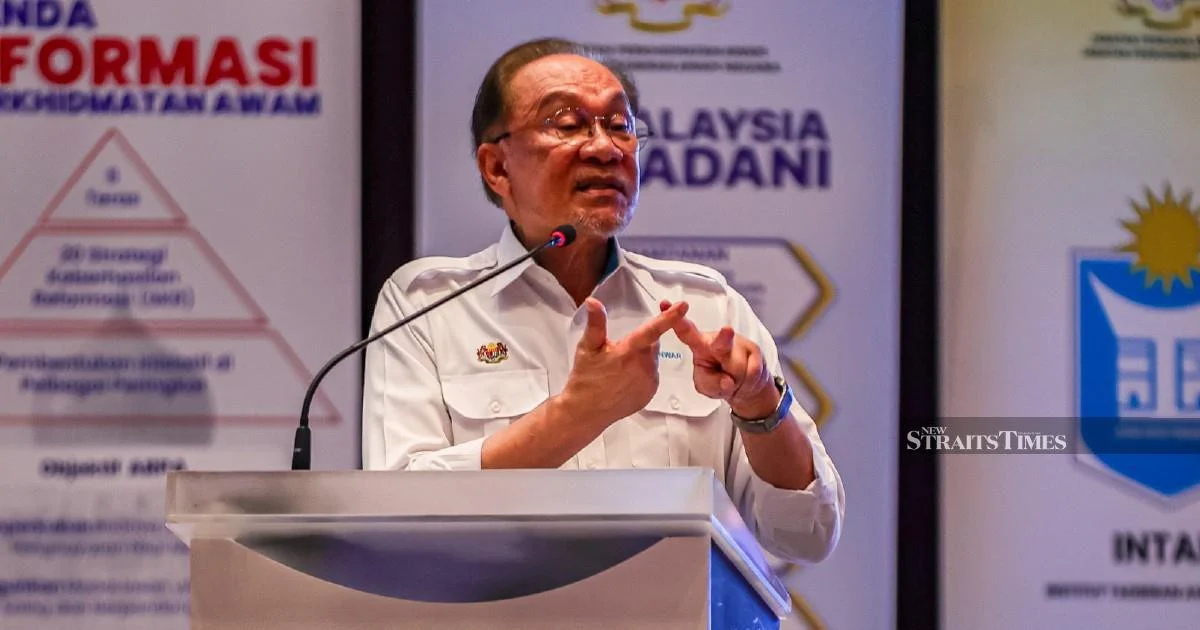
Prime Minister Datuk Seri Anwar Ibrahim has stepped in to quell mounting tensions within the ruling coalition, asserting that Amanah president Datuk Seri Mohamad Sabu made no disparaging remarks about any political partner during last Friday's Pakatan Harapan candidate announcement in Tangkak. The intervention represents an attempt to contain what appears to be growing friction among the diverse coalition that has governed Malaysia since the 2022 general election.
Anwar's statement, delivered in Alor Gajah, underscores the delicate balance required to maintain cohesion within the PH alliance, which comprises parties with markedly different ideological foundations and grassroots constituencies. The coalition unites the secular-leaning Democratic Action Party, the Malay-Muslim-focused Amanah and the economically-oriented Parti Keadilan Rakyat under a common electoral platform, a structure that frequently generates friction over policy direction and resource allocation.
The controversy surrounding Sabu's speech appears rooted in differing interpretations of remarks that some coalition members perceived as critical or dismissive. Such incidents, while perhaps minor in isolation, accumulate as warning signals within fragile political alliances where partners maintain competing interests beneath a facade of unity. The fact that the Prime Minister felt compelled to publicly defend Sabu suggests the matter had gained sufficient traction within coalition circles to warrant senior-level clarification.
Anwar's call for calm carries particular significance given Malaysia's electoral landscape. The government secured a working majority in the previous election but without the commanding dominance that would allow unilateral decision-making. This reality means coalition partners retain considerable leverage, and perceived slights can quickly metastasise into demands for ministerial portfolios, policy concessions, or candidate selection advantages during electoral contests.
Amanah, while numerically smaller than its coalition partners, holds strategic importance in Malay-majority constituencies where party president Sabu commands considerable personal support. His profile within PH extends beyond factional loyalty; Sabu represents a bridge between moderate Islam and secular governance models, a positioning that makes him simultaneously valuable and potentially contentious within a coalition encompassing more conservative Islamic voices and liberal democratic forces.
The broader context involves upcoming electoral considerations where candidate selection becomes a flashpoint for intra-coalition disputes. Decisions about who represents PH in winnable seats directly affect each party's parliamentary representation, resource allocation, and influence over cabinet composition. When one partner perceives another as monopolising prime nomination opportunities or securing disproportionate advantage, resentment builds rapidly regardless of coalition rhetoric emphasizing collective purpose.
Anwar's intervention reflects the demanding role of coalition leadership, where the Prime Minister functions as arbiter and peacekeeper alongside his statutory duties. His explicit statement that Sabu harboured no mocking intent serves as a circuit-breaker, providing coalition partners with political cover to de-escalate without losing face. This diplomatic maneuver is essential because public disputes within governing coalitions erode voter confidence and invite opposition parties to exploit visible fractures.
The Tangkak candidate announcement itself illustrates the mechanism through which tensions emerge. Such events require calibration of tone and emphasis to signal fairness to all coalition members while maintaining party-specific messaging. When different partners perceive the same speech through contrasting lenses—one hearing balanced coalition spirit, another detecting veiled criticism—structural vulnerability becomes apparent.
For Malaysian politics more broadly, this incident exemplifies the challenges inherent in multi-party coalitions governing a pluralistic nation. Unlike single-party governments, coalition structures distribute power among competing factions, necessitating constant negotiation, compromise, and judicious public statements that simultaneously reassure partners and project unified governance to the electorate. The cost of managing such arrangements manifests in opportunities foregone and decisions delayed while consensus builds.
The episode also highlights how statements that might occasion minor comment in more homogeneous governing arrangements acquire magnified significance within coalition contexts. Every public utterance by senior coalition figures becomes subject to forensic analysis by partner parties seeking evidence of shifts in relative standing or ideological direction. This heightened sensitivity reflects deeper anxieties about electoral competitiveness and post-election power distribution.
Moving forward, Anwar's statement appears designed to establish clear boundaries about acceptable coalition rhetoric while affirming that partner parties retain legitimate space for distinct voices. The message essentially tells coalition members that internal disagreements need not trigger public accusations of mockery, that measured criticism remains compatible with partnership, and that escalation serves no one's interests.
The sustainability of the PH alliance ultimately depends on whether partners can maintain sufficient goodwill and pragmatic self-interest to navigate inevitable disagreements without allowing them to rupture public facade. Anwar's intervention suggests coalition architects remain committed to managing tension rather than allowing it to explode into open conflict that would invite opposition advances and potentially destabilise Malaysian governance stability.

