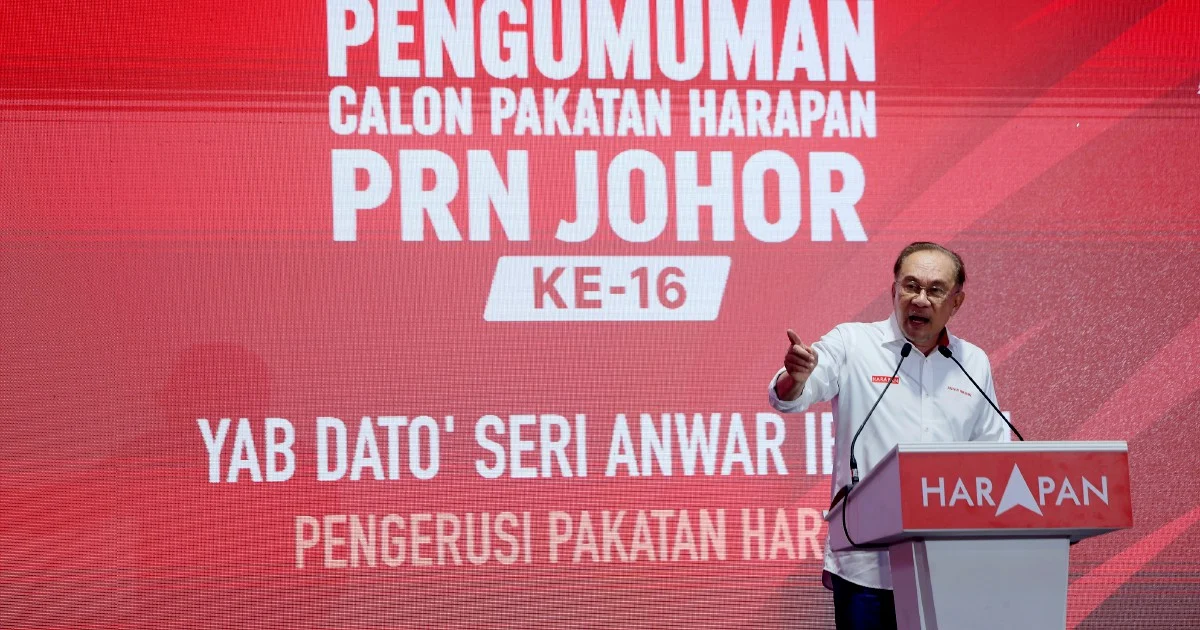
Prime Minister Datuk Seri Anwar Ibrahim has called on Johor's executive councillor to rigorously examine assertions from the previous Barisan Nasional and Perikatan Nasional federal governments concerning whether the state was shortchanged on revenue distribution. The remarks, delivered during a campaign stop in Tangkak, reflect growing scrutiny of how federal funds have been allocated to Johor under successive administrations, a matter that remains politically charged in the southern state.
The directive represents part of a broader strategy by the current Pakatan Harapan-led administration to highlight potential financial grievances accumulated during earlier governance periods. By encouraging Johor officials to actively investigate these claims, Anwar is effectively placing the onus on the state's executive branch to challenge the accounting practices of predecessor governments—a move that carries both political and administrative implications. This approach allows the federal government to address the revenue question while maintaining that state-level authorities are driving the inquiry independently.
Johor's revenue situation carries particular significance for Malaysian politics, given the state's economic importance and its position as a swing constituency in the nation's electoral calculations. The state has long maintained that its contribution to federal coffers outweighs what it receives in return, a grievance that gained prominence during the Perikatan Nasional period. These concerns have periodically surfaced across different administrations, suggesting the issue transcends simple partisan dispute and touches on structural questions about federal fiscal federalism in Malaysia.
The revenue distribution framework that governs how federal resources flow to states remains opaque to most Malaysians, with detailed breakdowns rarely made public. This opacity has created space for political parties to make competing claims about which states are favoured or disadvantaged under existing arrangements. Johor's case illustrates how such disputes can become weaponised during electoral contests, with various coalitions arguing that their governance would deliver a fairer financial settlement. The state's development status, population size, and economic output all factor into these calculations, yet the precise formula used by Treasury officials remains largely technical and inaccessible to popular scrutiny.
Anwar's intervention suggests that the current federal government recognises the value of revisiting these historical grievances, particularly as electoral considerations approach. By endorsing the examination of claims that previous governments treated Johor unfairly, the Prime Minister is attempting to position his administration as more attentive to the state's interests than its predecessors. This messaging strategy proves especially relevant in Johor, where electoral fortunes often depend on demonstrating tangible federal commitment and responsiveness to local demands.
The involvement of Johor's executive councillor in investigating these assertions underscores the federalised nature of Malaysia's political structure, where state-level officials possess both motivation and ostensible independence to challenge federal policies. However, the reality that most state exco members belong to parties aligned with the federal coalition complicates any notion of genuine independence. Such structural considerations mean that inquiries initiated by state officials often reflect broader federal coalition interests rather than purely localist concerns.
For Southeast Asian observers monitoring Malaysia's federal governance, the Johor revenue question exemplifies persistent tensions within federalised systems where wealthier or more economically productive states believe they are subsidising less developed regions. These distributional conflicts emerge regularly across the region, from Indonesia to India, and rarely yield definitive resolutions because they touch on fundamental political questions about national solidarity versus regional equity. Malaysia's approach of allowing such disputes to resurface periodically without establishing formal, transparent mechanisms for resolution creates ongoing political vulnerability.
The historical record shows that federal-state revenue disputes have influenced political alignments in Johor repeatedly. The state's oscillation between different ruling coalitions often correlates with fluctuations in perceived federal generosity. Anwar's current intervention therefore carries strategic weight beyond the immediate fiscal question—it signals to Johor voters that the federal government recognises their grievances and stands ready to address them, a positioning that becomes increasingly important as electoral cycles intensify.
Moving forward, the question of whether substantive investigations into historical revenue claims will occur remains open. Federal treasuries worldwide resist detailed audits of their distributional decisions, given the administrative complexity and political sensitivity involved. In Malaysia's case, such examinations would require unpacking decades of budget allocations, subsidy arrangements, and infrastructure investments—a mammoth undertaking unlikely to yield clear answers about whether Johor was genuinely shortchanged. Nevertheless, the symbolic value of Anwar directing attention to this question may itself constitute the primary political objective, rather than the outcome of any formal inquiry.
The broader implications extend to how Malaysian federalism manages centre-state relations in an era of widening electoral competition. As the country navigates plural politics with multiple viable coalitions, federal governments must increasingly accommodate regional grievances and concerns to maintain electoral support. Whether this leads to more transparent, equitable revenue systems or merely to more politically sophisticated management of distributional disputes remains to be seen, but Anwar's Johor intervention suggests the latter pattern prevailing for now.

