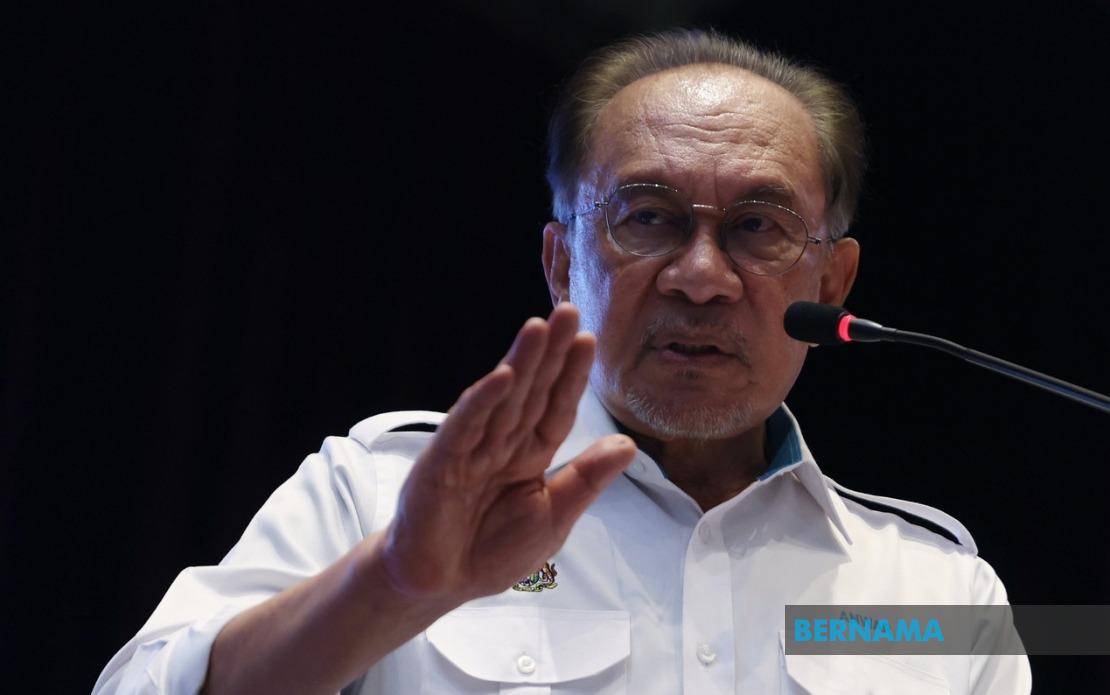
Prime Minister Datuk Seri Anwar Ibrahim has issued a firm reminder to the nation's political establishment that the institution of the Malay Rulers must remain insulated from the cut-and-thrust of electoral campaigns and partisan disputes. Speaking in Alor Gajah on June 24 after a civil service engagement event, Anwar stressed the critical importance of maintaining the sanctity of the monarchy amid the inevitable tensions that accompany election season.
The Premier's intervention appears to have been prompted by recent statements made by Amanah party president Datuk Seri Mohamad Sabu during Pakatan Harapan's candidate announcement in Johor on Monday. Several political observers and commentators interpreted those remarks as containing veiled criticisms directed at the royal institution, a characterisation that appears to have prompted Anwar's public rebuke of the practice. The incident underscores the delicate balance required in Malaysian politics, where the monarchy occupies a constitutionally protected and culturally revered position that transcends ordinary partisan competition.
Anwar's statement reflects a long-standing convention in Malaysian democratic practice that distinguishes between the elected political leadership and the constitutional monarchy. While robust political debate is encouraged and expected—particularly during campaigns—the custom has traditionally held that institutions embodying national unity and constitutional authority should remain above the fray. The Prime Minister framed his comments as an appeal to political maturity, suggesting that disagreements among politicians and their parties should be resolved through established channels of political discourse rather than by invoking sacred national symbols.
The timing of Anwar's remarks carries particular significance for Malaysia's political trajectory. In recent years, the nation has witnessed increasing polarisation across factional lines, with various actors occasionally testing the boundaries of what constitutes acceptable political commentary. By personally intervening to establish clear norms around the monarchy's role in electoral contests, Anwar positioned himself as a guardian of constitutional conventions at a moment when such guardianship appears necessary. The statement sends a signal that his administration, regardless of its partisan affiliations, will not tolerate attempts to instrumentalise the monarchy for political advantage.
The broader context for this intervention lies in Malaysia's complex constitutional framework, wherein the Malay Rulers hold significant ceremonial, symbolic, and in certain instances substantive constitutional powers. Any erosion of public confidence in the monarchy's impartiality could theoretically undermine social cohesion and the stability of the constitutional order itself. Thus, maintaining clear boundaries between the political realm and the institution of the Malay Rulers is not merely a matter of political etiquette but touches upon fundamental questions of institutional integrity and national harmony.
For Southeast Asian observers, Malaysia's approach to protecting the monarchy from partisan entanglement offers instructive contrast to other regional democracies. Unlike some neighbouring nations where the institution has become increasingly embroiled in political contestation, Malaysia has historically maintained stricter separation between the Crown and electoral competition. Anwar's statement represents a conscious reaffirmation of this principle, even as the political landscape evolves and new actors test established boundaries.
The gathering where Anwar made his comments also served a broader purpose of civil service engagement. Held at the Public Works Department's Centre of Excellence for Engineering and Technology in Melaka, the event demonstrated the administration's ongoing efforts to connect with the public sector workforce. Melaka Chief Minister Datuk Seri Ab Rauf Yusoh and Deputy Higher Education Minister Adam Adli Abd Halim were among those in attendance, reflecting the inter-governmental nature of the occasion and suggesting that the monarchy issue, while important, formed part of a larger conversation about governance and public service.
The presence of senior civil service officials including Public Service director-general Datuk Seri Wan Ahmad Dahlan Abdul Aziz indicated that the event served multiple functions. Such gatherings allow political leadership to communicate directly with the machinery of government while also offering opportunities to reiterate expectations regarding professional conduct and adherence to constitutional principles. For the civil service, which operates within a strict code of political neutrality, Anwar's reminder about respecting institutional boundaries may carry particular resonance.
The Amanah president's original comments have not been publicly detailed in full, leaving some ambiguity about precisely what prompted the Prime Minister's response. However, the episode illustrates how campaign season can generate sensitivities around constitutional institutions, particularly when political parties seek to mobilise support around divisive issues. Whether Mohamad Sabu's remarks were deliberately provocative or simply interpreted through a particular lens remains somewhat unclear, but their effect has been to provoke this high-level intervention from the nation's highest elected official.
For Malaysian political parties and their leaders, Anwar's message is unambiguous: the monarchy sits outside the normal realm of electoral competition, and attempts to drag the institution into partisan disputes risk violating fundamental constitutional conventions. This stance aligns with constitutional Article 4, which guarantees the position and privileges of the constitutional monarchy, suggesting that Anwar is anchoring his political intervention in constitutional principle rather than mere preference. The reminder comes as a timely calibration of political norms as campaigns intensify.
Moving forward, Anwar's intervention may establish a template for how the government responds to similar incidents. By speaking directly and clearly about expected standards of political conduct regarding the monarchy, the Prime Minister has created a reference point for assessing future statements and conduct. Political actors who now venture into territory that associates the Malay Rulers with partisan disputes risk being perceived as violating an explicitly articulated norm, backed by the authority of the highest political office in the land.
The incident and official response also reflect Malaysia's broader project of democratic maturation. Rather than relying solely on informal conventions or legal prohibitions, senior leaders actively communicate expectations about institutional respect and constitutional propriety. This proactive approach to norm-setting suggests that political leadership recognises the importance of maintaining public confidence in the neutrality and integrity of constitutionally protected institutions, particularly during periods of heightened political contestation when precedent and custom face their greatest tests.

