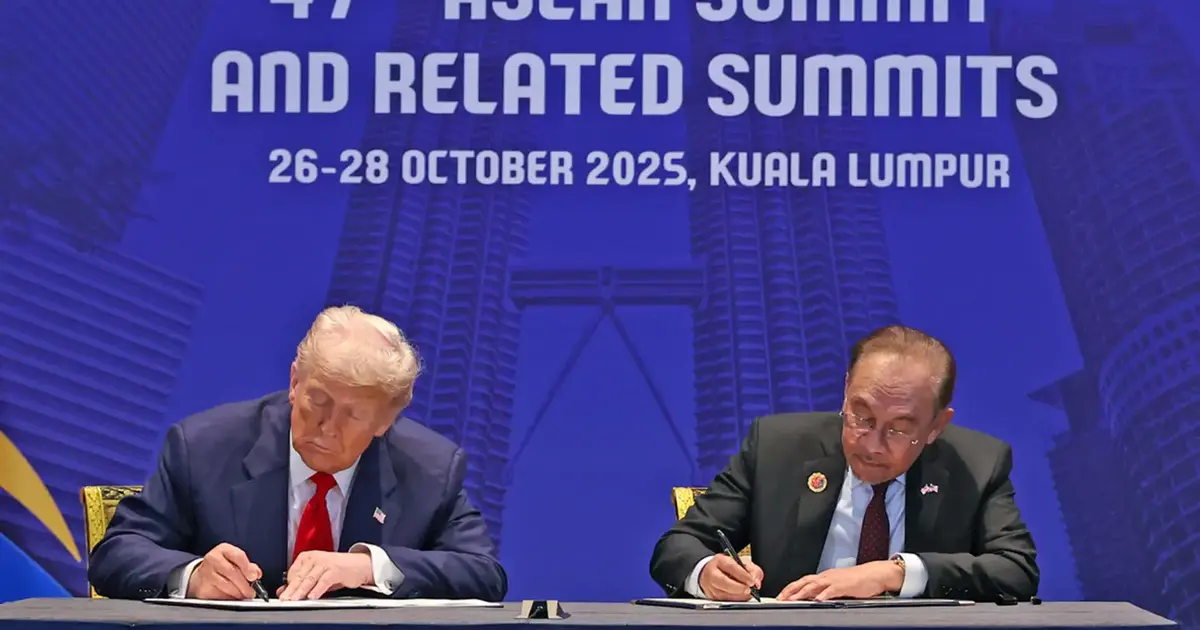
Prime Minister Anwar Ibrahim's administration has taken aggressive legal action to block a high-profile challenge to the Malaysia-US reciprocal trade agreement, filing an application to strike out a suit filed by opposition Members of Parliament. The move represents a critical juncture in the ongoing political and constitutional dispute surrounding the bilateral trade pact, which has become a focal point of tension between the government and its parliamentary opponents.
The opposition MPs have simultaneously advanced their own legal strategy by submitting an application requesting that constitutional questions arising from the matter be referred directly to the Federal Court. This dual approach signals the opposition's determination to escalate the dispute beyond the ordinary court system and force a judicial examination of fundamental constitutional principles governing Malaysia's trade-making authority and parliamentary oversight.
The Malaysia-US reciprocal trade agreement has emerged as a contentious policy issue, with critics questioning whether the government properly consulted Parliament and obtained the necessary approvals before proceeding with implementation. The reciprocal nature of the agreement—involving mutual tariff reductions and market access commitments—has generated concerns among opposition lawmakers and civil society observers about potential impacts on local industries and workers without adequate parliamentary scrutiny or public debate.
The government's application to strike out the opposition MPs' suit represents a frontline legal strategy to prevent the case from proceeding to trial. By seeking dismissal at an early stage, the administration aims to avoid prolonged litigation that could undermine government credibility and generate sustained negative publicity regarding its trade negotiation processes. Such dismissal applications typically argue that the plaintiff lacks legal standing, the matter is not justiciable, or the suit fails to disclose a legally cognisable cause of action.
Constitutional law experts across Southeast Asia have noted that Malaysia's courts increasingly face requests to examine the interaction between executive prerogative in trade matters and parliamentary constitutional authority. The Federal Court referral sought by the opposition MPs could fundamentally reshape how Malaysia handles international trade agreements, potentially establishing precedent that requires stronger parliamentary involvement or ratification procedures for future bilateral and multilateral trade negotiations.
The timing of this dispute carries significant political weight, occurring within a complex parliamentary landscape where government coalition stability remains a constant calculation. Anwar Ibrahim's administration, despite commanding a parliamentary majority, navigates complex coalition dynamics that make external legitimacy for major policy decisions politically advantageous. A court judgment upholding parliamentary prerogatives over trade matters could strengthen opposition political leverage and complicate future economic policymaking.
The Malaysia-US trade relationship occupies a critical position within regional geopolitics and economic strategy. As the United States strengthens its presence in Southeast Asia through bilateral trade arrangements, Malaysia's approach to reciprocal agreements signals broader positioning regarding great power competition and regional economic integration. The opposition's legal challenge reflects domestic concerns about whether such arrangements serve ordinary Malaysian workers and small-to-medium enterprises adequately, or primarily benefit large corporations and multinational investors.
The Federal Court referral pathway pursued by opposition MPs represents a more ambitious legal strategy than simply defending the initial suit. Constitutional questions, once properly framed and submitted, command the highest judicial authority and produce binding precedent across Malaysia's entire court system. This approach could generate consequences far beyond the immediate Malaysia-US agreement, potentially affecting how the government conducts future international negotiations and implements their terms domestically.
Industry observers note that reciprocal trade arrangements typically involve complex tariff schedules, rules of origin provisions, and sectoral commitments that demand sustained parliamentary engagement and oversight. Critics argue that Malaysia's traditional practice of minimal legislative scrutiny for trade agreements reflects historical colonial-era arrangements that warrant recalibration for contemporary governance standards. The opposition's legal challenge attempts to establish precisely such recalibration through judicial intervention.
The government's decision to vigorously contest the opposition suit through striking-out applications signals confidence in its legal position while simultaneously acknowledging the political sensitivity surrounding the agreement. Legal victory in striking out the case would allow the administration to claim vindication while the opposition maintains that the court avoided examining substantive constitutional questions. Conversely, failure to strike out the suit would enable more searching judicial examination of trade agreement procedures, potentially generating unfavourable findings regarding government process and transparency.
Regional trade dynamics add further complexity to Malaysia's position. Other Southeast Asian nations observe how Malaysia navigates US trade engagement while managing relations with China and accommodating ASEAN multilateral commitments. The domestic constitutional dispute over parliamentary involvement in trade matters indirectly influences Malaysia's negotiating capacity and international credibility, as potential trading partners assess whether Malaysian commitments reflect durable government-parliament consensus or remain vulnerable to legal challenge.
The unfolding litigation will likely extend across months or years, with multiple procedural stages before substantive resolution. During this extended period, the Malaysia-US agreement exists in legal limbo, potentially complicating implementation planning and generating uncertainty for affected industries. This uncertainty itself becomes a political cost for the government, which must balance trade negotiations' perceived benefits against the litigation risks and administrative complications they generate.

