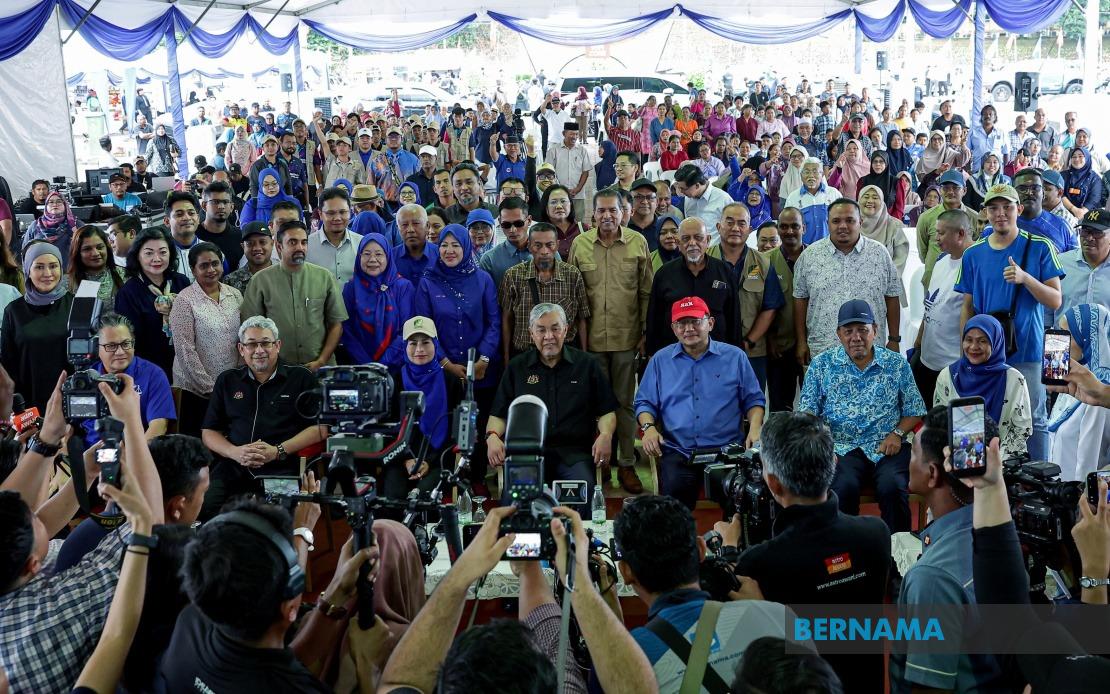
Deputy Prime Minister Datuk Seri Dr Ahmad Zahid Hamidi has made a direct appeal to every political party involved in the 16th Negeri Sembilan State Election to steer clear of inflammatory campaign messaging centred on race, religion, cultural differences and socioeconomic backgrounds. Delivering his remarks in Kuala Pilah on July 25 after inaugurating the Salam Agrikomoditi MADANI programme, the Barisan Nasional chairman underscored the importance of maintaining professional standards in political discourse, cautioning that leaders at all levels must resist the temptation to launch personal attacks or dredge up contentious identity-based grievances.
Ahmad Zahid's intervention arrives as the state election campaign enters its critical phase, with early voting scheduled for July 28 and polling day set for August 1. His emphasis on ethical conduct reflects broader concerns within the federal government about election discourse degenerating into communal tensions. The Deputy Prime Minister stressed that while political parties may hold fundamentally divergent views on policy matters, these disagreements should be articulated through substantive debate rather than inflammatory rhetoric targeting individuals or historical grievances. The underlying message suggests that campaign season provides no justification for abandoning the norms of civilised political engagement that should undergird democratic competition.
Central to Ahmad Zahid's exhortation is the notion that voters deserve campaigns focused squarely on practical governance issues—infrastructure development, economic opportunity, service delivery, and social welfare—rather than appeals designed to mobilise voters along ethnic or religious lines. He contended that political leaders bear a particular responsibility to model the unity and respect for diversity that the federal government has been attempting to foster through the Unity Government framework. By extension, his remarks suggest that state-level politics should reflect the collaborative spirit supposedly animating national governance, even when parties disagree on substantive matters.
The Barisan Nasional chairman also reiterated his coalition's unwavering commitment to supporting Prime Minister Datuk Seri Anwar Ibrahim and the MADANI Government through the remainder of the current federal administration's term. This declaration carries significance because it addresses persistent speculation within political circles about whether BN might exploit factional divisions or organisational weakness to engineer political realignment at the national level. Ahmad Zahid's unambiguous reaffirmation effectively closes off such speculation, at least on the record, and signals that the ruling coalition intends to maintain its current configuration regardless of outcomes in state elections. This commitment to stability at the federal level stands in contrast to the volatile state-level electoral contests that periodically test the Unity Government's resilience.
Simultaneously, UMNO vice-president Datuk Seri Mohamed Khaled Nordin issued a clarification regarding BN's arrangement with Perikatan Nasional in the Negeri Sembilan contest. Speaking at Pasir Gudang in Johor following the UMNO Division delegates' meeting, he emphasised that the understanding between the two coalitions represents nothing more than a pragmatic electoral accommodation designed to prevent three-way contests in selected constituencies. Khaled Nordin's intervention appeared aimed at forestalling misinterpretation of the seat-sharing arrangement as evidence of deeper merger discussions or ideological realignment between these rival political forces. His distinction between tactical cooperation and structural merger carries real significance, as past speculation about coalition reconfiguration has occasionally spooked investors and complicated governance narratives.
The timing of these pronouncements underscores the heightened sensitivity surrounding state elections in Malaysia's current political climate. Negeri Sembilan, like other state contests, has become a test case for federal political dynamics and coalition stability. Electoral results in these contests send signals throughout Malaysia's political establishment about shifting voter preferences, the effectiveness of government policies, and the relative strength of competing political narratives. A decisive victory for the governing coalition reinforces the legitimacy of the Unity Government arrangement, whilst setbacks invite speculation about weakening federal authority or emerging realignments among political actors. Ahmad Zahid's pre-election appeals therefore serve dual purposes: they establish clear ethical benchmarks for campaign conduct whilst simultaneously reinforcing the narrative that national political unity should be reflected in state-level politics.
The Deputy Prime Minister's invocation of ethical standards and his criticism of personal attacks carried particular weight given Malaysia's history of election campaigns marked occasionally by acrimonious personal exchanges and communal tensions. By framing the appeal in terms of professional conduct and leadership responsibility, rather than merely partisan advantage, Ahmad Zahid positioned these guidelines as matters of democratic principle rather than tactical preference. His audience included not only the assembled candidates and party operatives but also Malaysian voters contemplating their electoral choices in early August. The implicit argument advanced through his remarks suggests that voters themselves should prize candidates and parties willing to engage in substance-focused debate over those resorting to identity-based mobilisation or personal disparagement.
The Negeri Sembilan election unfolds against the backdrop of Malaysia's broader political transformation over the past several years, during which established party hierarchies have been disrupted, traditional coalition boundaries have shifted, and voters have demonstrated willingness to vote against incumbent governments when discontented. State elections serve as important barometers of public sentiment regarding federal government performance, particularly concerning economic management and the distribution of development resources. Ahmad Zahid's emphasis on policy-focused campaigning thus reflects official acknowledgment that voters increasingly base electoral decisions on tangible governance outcomes rather than historical party loyalties or communal identity appeals alone.
The Deputy Prime Minister's statement also carries implications for how Malaysian political actors communicate during election seasons more broadly. His explicit rejection of race and religion-based campaign messaging aligns rhetorically with national unity goals articulated by the federal government, yet implemention of such guidelines depends upon voluntary compliance by competing parties and candidates operating within constituencies where appeals to communal sentiment have traditionally proven electorally effective. Whether Ahmad Zahid's call translates into measurably different campaign conduct in Negeri Sembilan remains uncertain, though his public positioning establishes clear accountability standards against which observers can measure actual campaign behaviour. The Deputy Prime Minister's remarks ultimately represent an attempt to elevate election discourse standards whilst simultaneously reinforcing the federal government's commitment to Unity Government principles at the state level.

