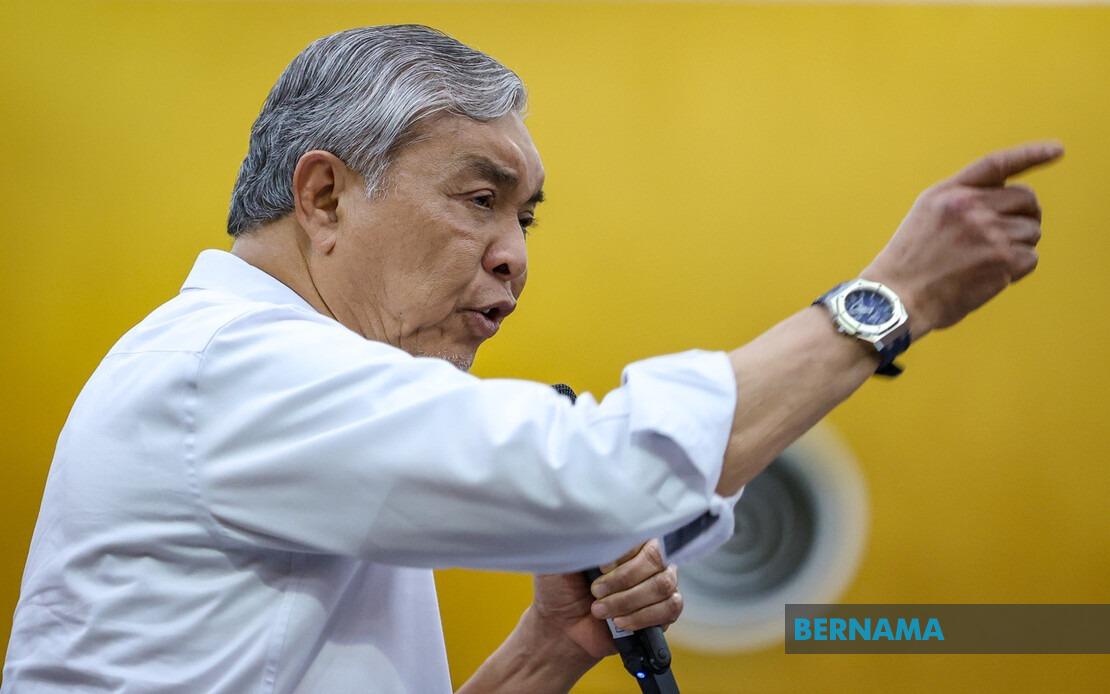
Deputy Prime Minister Datuk Seri Dr Ahmad Zahid Hamidi has unveiled a proposal to equip campus student leaders with structured training in governance and political systems, arguing that such preparation would help cultivate a politically literate generation better equipped to navigate Malaysia's complex institutional landscape. Speaking in Johor Bahru on July 9, Ahmad Zahid suggested that Student Representative Councils (MPP) across the nation's higher education institutions should access specially designed courses to deepen their comprehension of democratic principles and contemporary political dynamics affecting the country.
The timing of this intervention reflects broader concerns among Malaysia's political establishment about young voters' engagement with electoral processes and civic institutions. At a moment when campuses traditionally serve as incubators for future leaders, Ahmad Zahid's remarks suggest that current student council representatives may lack sufficient grounding in political fundamentals to effectively advocate for their peers or contribute meaningfully to national discourse. His proposal attempts to address this perceived gap by formalising political education rather than leaving such learning to happenstance or informal mentorship.
Financial commitment underpins the proposal's viability. Ahmad Zahid indicated that the government stands ready to underwrite the costs of these courses, contingent upon requests from interested MPPs and subsequent clearance from Higher Education Minister Datuk Seri Dr Zambry Abd Kadir. This funding arrangement suggests serious intent beyond rhetorical posturing, though implementation details remain sparse. The financial backing signals that the initiative transcends partisan positioning and reflects a calculated effort to influence institutional culture within universities, institutions that have historically maintained distance from direct political engagement.
The curriculum envisioned by the Deputy Prime Minister would expose student leaders to the operational mechanics of Malaysia's political system while simultaneously broadening their understanding of electoral mechanics and party dynamics. By framing such education as exposure rather than indoctrination, Ahmad Zahid attempts to navigate the sensitive terrain of political neutrality that universities traditionally guard. The courses would theoretically equip participants to comprehend competing ideological perspectives while developing analytical frameworks for evaluating policy proposals and political movements.
Ahmad Zahid's own trajectory illustrates his implicit argument. Having served as a student leader at Universiti Malaya, he drew upon that formative experience to construct a political career that ultimately reached the cabinet level. His biographical reference suggests that systematic political education during university years can produce leaders capable of steering national institutions, though critics might note that his path also reflects privileged access to networks and mentorship unavailable to ordinary students. Nevertheless, the precedent of his ascent provides justification for his belief that campus-based political training merits investment.
Importantly, Ahmad Zahid stopped short of asserting that young Malaysians must embrace active political participation to fulfill civic responsibilities. Instead, he advanced a more nuanced position distinguishing between political activism and political awareness. This distinction carries significance for a nation where university administrations traditionally restrict partisan student activities while nominally encouraging civic engagement. By positioning informed voting and political literacy as baseline expectations rather than demands for active mobilisation, Ahmad Zahid's framing creates space for the government to fund education programmes without appearing to instrumentalise student organisations for partisan recruitment.
The focus on voting behaviour and electoral responsibility addresses a separate anxiety animating political leadership across Malaysian factions. Ahmad Zahid emphasised that eighteen-year-old and first-time voters should recognise the consequential nature of their ballot choices, framing electoral participation as a fundamental democratic right that carries real implications for national direction and party leadership selection. This emphasis reflects concern that youth voters, particularly those participating in elections for the first time, may treat voting as peripheral to their concerns or fail to understand how aggregate electoral outcomes reshape political landscape and policy priorities.
The proposal arrives as Johor prepared for state elections scheduled for the following Saturday, with fifty-six state seats contested across the jurisdiction. While Ahmad Zahid's remarks ostensibly address nationwide student governance structures, the proximity to Johor polling suggests that bolstering campus engagement and young voter participation holds tactical significance for the ruling coalition. By investing political capital in youth political education just as elections approached, the government positioned itself as stakeholder in cultivating informed democratic participation even as it simultaneously sought to influence the demographic group whose turnout could materially affect electoral outcomes.
For Malaysian universities, the proposal raises questions about institutional autonomy and the appropriate boundaries of government involvement in student affairs. While framing the courses as enhancement of democratic understanding rather than political training, the government's offer of funding creates potential leverage over curricular content and instructor selection. Universities accustomed to maintaining arm's-length relationships with political authorities may find themselves navigating delicate negotiations around academic freedom versus resource acquisition, particularly when financial constraints limit alternative funding sources.
The broader implications extend beyond individual campuses to Malaysia's evolving relationship with youth civic engagement. As demographic shifts increase the relative political weight of younger voters and as digital connectivity exposes Malaysian young people to diverse political information sources, establishing standardised frameworks for political education could either deepen democratic participation or serve as subtle mechanism for promoting particular ideological perspectives. The success of Ahmad Zahid's proposal ultimately depends upon implementation architecture, instructor credentials, and institutional safeguards protecting educational integrity from political manipulation, dimensions that remain underdeveloped in his initial pronouncement.
Across Southeast Asia, Malaysia's emphasis on formalised political education for student leaders reflects broader regional trends toward state investment in youth institutional formation. While some neighbouring democracies have expanded civic education programmes to counteract misinformation and polarisation, others have utilised similar mechanisms to reinforce state-sanctioned narratives. Ahmad Zahid's proposal occupies this ambiguous middle ground, presenting legitimate democratic rationale while operating within a political context where government funding of education initiatives inevitably carries implications for content and outcomes that warrant careful scrutiny from civil society observers and academic institutions themselves.

