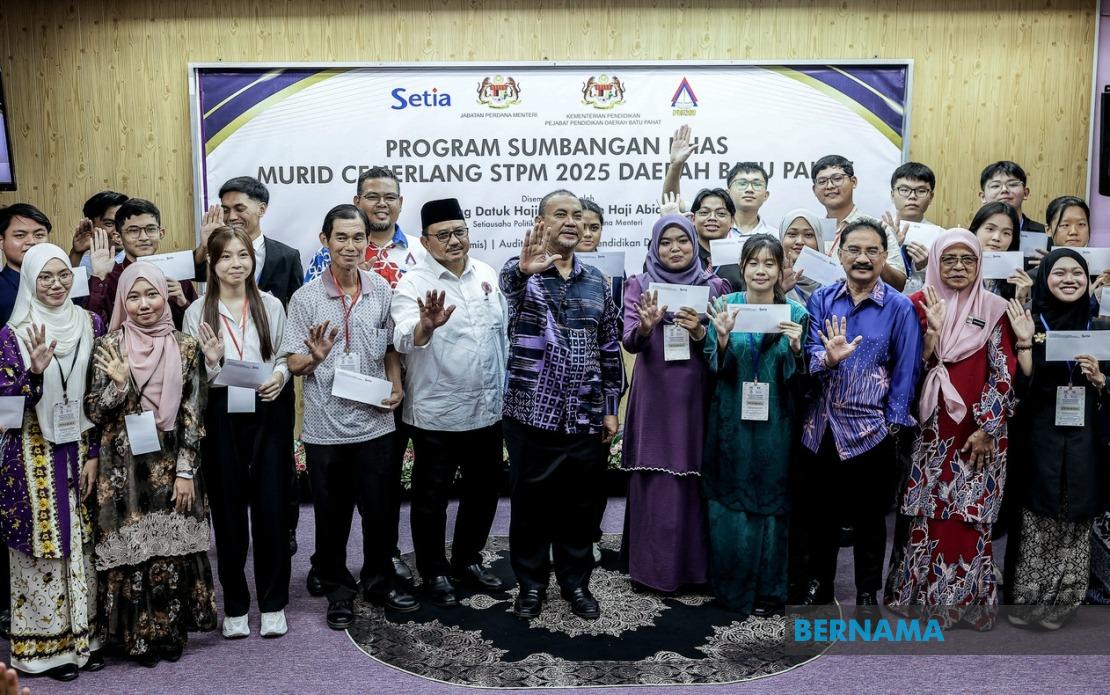
The Prime Minister's Office has distributed financial recognition to 214 exemplary students who completed their 2025 Sijil Tinggi Persekolahan Malaysia (STPM) examinations in Batu Pahat, marking a significant government investment in recognising academic achievement at the pre-university level. The awards ceremony, held at the Batu Pahat District Education Office auditorium, underscores the federal government's commitment to celebrating educational excellence while simultaneously supporting students' transition into higher learning institutions.
Datuk Azman Abidin, serving as Political Secretary to the Prime Minister, presented the special contributions and explained the broader policy rationale underlying the initiative. The awards encompassed former students from 16 secondary schools across the district, reflecting a geographically inclusive approach to recognition. Abidin framed the programme as fundamentally motivational, designed to inspire recipients to maintain their academic momentum and serve as role models within their respective school communities and beyond.
The government's positioning of this award scheme within its education policy framework reveals several strategic intentions. Beyond the immediate financial support provided to individual students, the initiative deliberately emphasises the government's role as an active stakeholder in celebrating youth achievement. This framing carries political significance in Malaysia's education narrative, where state support for high-performing students has traditionally been channelled through scholarships and direct university placements rather than recognition awards tied to a specific examination cohort.
According to Abidin's remarks, the programme operates under conditional funding arrangements, suggesting that its continuation and expansion depend on budgetary availability and cabinet prioritisation. He explicitly indicated that the government intends to extend the scheme to other districts and regions, positioning Batu Pahat as a pilot location for what could become a nationwide recognition framework. This phased expansion approach suggests the government is testing both the administrative feasibility and the public reception of the initiative before broader rollout.
Among the recipients was Afida Auni Airulnizam, a 20-year-old former student of Sekolah Menengah Kebangsaan Tun Sardon in Rengit, who articulated the personal significance of the recognition award. Her response highlighted how such government acknowledgement functions not merely as financial assistance but as psychological validation of her academic efforts. She identified her older brother, currently pursuing university studies, as her primary inspiration, establishing a familial context where both siblings navigate Malaysia's tertiary education pathway simultaneously.
Afida's stated intention to pursue sports science at the university level, contingent upon securing a tertiary placement, reflects broader demographic patterns among high-achieving STPM graduates. Her choice of a specialised scientific discipline, rather than mainstream commerce or engineering fields, points to diversification trends in Malaysian higher education aspiration among top performers. The recognition award potentially removes financial anxiety from her application and enrolment process, allowing her to focus on academic performance and course selection without resource constraints.
Muhd Ammar Firdaus Mohd Fadzil, also aged 20 and a former student of Sekolah Menengah Kebangsaan Tun Ismail, provided another recipient perspective emphasising the economic dimensions of the award. He explicitly noted that the contribution would alleviate the financial pressure associated with preparing for tertiary education, whether through application fees, examination repetition costs, or foundational course expenses. This observation underscores how financial barriers, even at the stage of transitioning from pre-university to university education, can hinder otherwise academically capable students.
The involvement of 16 secondary schools across the Batu Pahat district indicates that the award recipients reflect the broader ecosystem of secondary education in the region. The geographic spread suggests that excellent academic performance is not concentrated in a small number of elite institutions but distributed across the district's public school system. This finding potentially contradicts assumptions about educational inequality and could inform policy discussions about the effectiveness of Malaysia's secondary school governance structure.
For Malaysian education observers and policymakers, this initiative raises important questions about how governments should recognise and support high-achieving students during the critical transition between secondary and tertiary education. The provision of special contributions represents a departure from traditional scholarship approaches, which typically operate as competitive university-admission mechanisms. Instead, this scheme treats recognition and financial support as separate functions, allowing the government to celebrate achievement independent of subsequent university placement outcomes.
The practical implications for students in Batu Pahat extend beyond the immediate financial benefit. Recipients gain formal government recognition of their academic standing, which may enhance their credibility in university applications, particularly for merit-based or honours-track programmes. The public nature of the award ceremony amplifies this effect, generating local media attention and establishing recipients as exemplars within their communities.
Looking at the broader Southeast Asian context, Malaysia's approach to recognising pre-university excellence reflects wider regional trends toward institutionalising meritocratic frameworks in secondary and tertiary education. Countries across the region have increasingly adopted tiered recognition systems that identify high performers at multiple educational checkpoints. Malaysia's STPM Top Achievers Award Ceremony initiative aligns with this regional momentum, though its reliance on discretionary government funding distinguishes it from permanent scholarship structures in neighbouring countries.
The conditional nature of the programme's continuation, explicitly dependent on budgetary availability, introduces an element of uncertainty that contrasts with established scholarship systems. This funding volatility could potentially affect students' planning processes if the award's availability becomes unpredictable across examination cohorts. However, the government's stated intention to expand the scheme to other locations suggests a commitment to institutionalising the initiative within its broader education policy framework.

