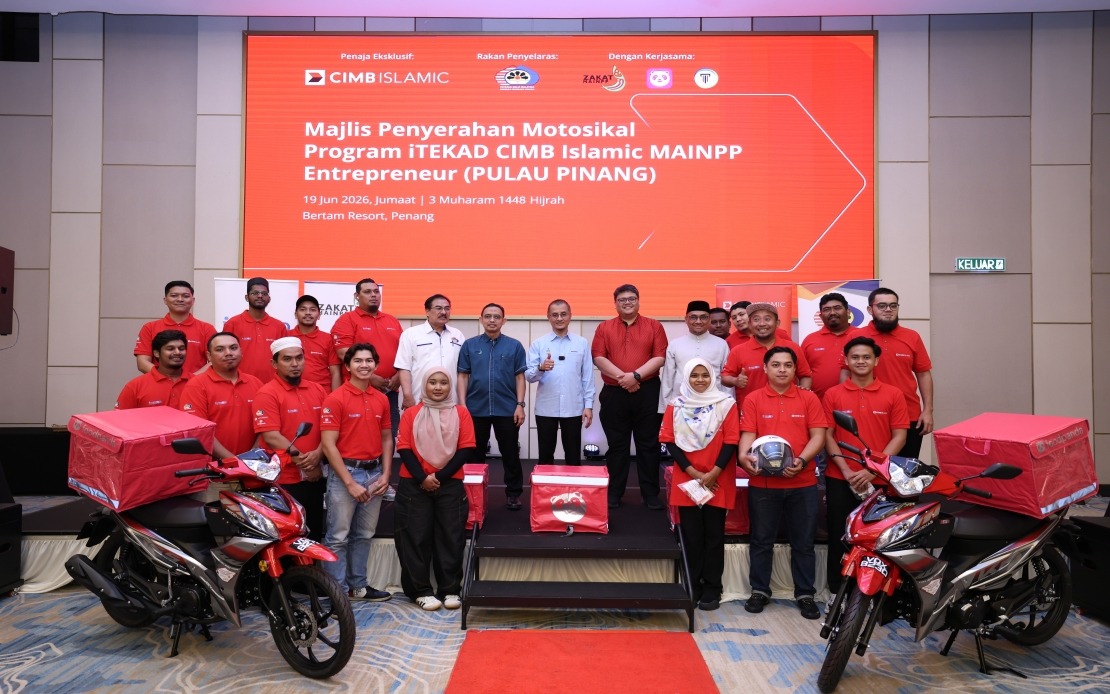
Twenty carefully selected asnaf members in Penang have been handed motorcycles as part of an integrated entrepreneurship initiative designed to lift them out of poverty and into viable self-employment. The motorcycles and related business equipment were distributed at a ceremony in Kepala Batas, representing tangible support for participants who survived a competitive selection process spanning multiple stages and culminating in an intensive residential bootcamp in late May and early June.
The iTEKAD CIMB Islamic-MAINPP Entrepreneur programme operates as a partnership between three main stakeholders: CIMB Islamic Bank Berhad, the Penang Islamic Religious Council known as MAINPP, and implementation partners including the Malaysian Youth Foundation, Taylor's Community, and foodpanda Malaysia. According to Penang Deputy Chief Minister I Datuk Dr Mohamad Abdul Hamid, who oversaw the handover ceremony, this collaboration underscores a critical principle in poverty-alleviation work—that sustainable change requires coordinated effort rather than isolated interventions by single organisations.
The initiative drew funding through multiple channels, creating a RM400,000 seed fund structured as a matching grant. CIMB Islamic Bank contributed RM200,000 from its Wakalah Zakat fund, while Bank Negara Malaysia provided an equivalent RM200,000. This dual-source financing model demonstrates how institutional zakat allocation can be amplified through strategic public-sector partnerships, a framework increasingly relevant across Malaysia's Islamic finance sector as Zakat MAINPP and similar bodies expand their role beyond traditional welfare distribution.
The programme attracted substantial initial interest, with Zakat MAINPP receiving 151 applications from individuals seeking to transform their economic circumstances. This demand reflects persistent challenges faced by asnaf communities—those defined as eligible beneficiaries under Islamic law—who often lack access to productive capital and structured pathways into viable enterprise. The high application volume also suggests that combining financial assets with professional support mechanisms creates compelling appeal for those trapped in precarious income situations.
Selection methodology proved rigorous, moving beyond simple application review to encompass personal interviews and a four-day Entrepreneurship Camp held from May 31 to June 3. This intensive vetting process served dual purposes: evaluating genuine entrepreneurial potential and capability while simultaneously beginning the mentorship journey for those selected. By the time participants received their motorcycles, they had already absorbed foundational knowledge in business fundamentals and personal discipline—essential preparation for self-employment ventures.
Beyond the motorcycles themselves, recipients gained access to delivery equipment and comprehensive training modules spanning financial management basics, workplace discipline, and entrepreneurship principles. The partnership with foodpanda Malaysia appears strategically significant, as the platform offers immediate opportunity for motorcycle-based delivery work—a sector experiencing expansion across Southeast Asia. This practical pathway differs markedly from programmes that distribute assets without employment clarity, instead embedding participants into functional economic ecosystems from day one.
Mohamad's remarks highlighted how the scheme aligns with Penang's broader Islamic Religious Development Agenda 2030, a long-term framework encompassing education, economic opportunity, family stability, and youth engagement. This positioning suggests the motorcycles represent not isolated charity but part of coherent state strategy addressing multidimensional aspects of community development. Such integration distinguishes contemporary asnaf-support initiatives from earlier welfare-focused approaches, emphasising economic participation and capability building.
The programme's emphasis on stability and income generation rather than temporary relief carries particular weight for Malaysia's asnaf population, estimated at several million individuals nationwide. Motorcycle-based delivery and transport work offers scalability advantages—participants can expand beyond foodpanda into other platforms or eventually transition to alternative enterprises using the same asset base. The training components, meanwhile, address skills gaps that often constrain asnaf advancement even when capital constraints ease.
From a Zakat governance perspective, the iTEKAD model illustrates evolving sophistication in how Islamic charitable funds deploy resources. Rather than dispersing zakat as consumption assistance, MAINPP channels it toward productive asset accumulation coupled with capability development. This approach acknowledges that sustained poverty reduction requires addressing both capital shortage and capability deficits simultaneously—a recognition increasingly central to discussions within Malaysia's zakat administration circles.
The programme's success metrics will likely extend beyond immediate income generation to encompassing longer-term participant trajectories. Early monitoring of the 20 recipients will reveal retention rates, average monthly earnings, and progression toward additional enterprises or asset acquisition. Such data collection would inform future iterations and strengthen the case for replicating similar models across other Malaysian states, each potentially customised to local labour market conditions and asnaf demographic profiles.
For broader Southeast Asian context, Malaysia's structured approach to asnaf empowerment through bank-council collaboration offers an interesting model. As Islamic finance sectors mature across the region and zakat administration becomes increasingly professionalised, other countries may adapt components of programmes like iTEKAD. The explicit combination of asset provision, training, platform access, and ongoing support represents a comprehensive intervention package that addresses recognised constraints on asnaf economic mobility.

